

Commentary
Just look at Iraq in 1991.
Marwan Muasher
{
  "authors": [
    "Amr Hamzawy",
    "Andrew Leber",
    "Marwan Muasher",
    "Sarah Yerkes"
  ],
  "type": "questionAnswer",
  "blog": "Emissary",
  "centerAffiliationAll": "dc",
  "centers": [
    "Carnegie Endowment for International Peace"
  ],
  "collections": [
    "Regional Security in the Middle East and North Africa"
  ],
  "englishNewsletterAll": "menaTransitions",
  "nonEnglishNewsletterAll": "",
  "primaryCenter": "Carnegie Endowment for International Peace",
  "programAffiliation": "MEP",
  "programs": [
    "Middle East"
  ],
  "projects": [],
  "regions": [
    "Middle East",
    "Israel",
    "Palestine",
    "Saudi Arabia",
    "Qatar",
    "Morocco",
    "United States",
    "United Arab Emirates"
  ],
  "topics": [
    "Domestic Politics",
    "Foreign Policy",
    "Security"
  ]
}
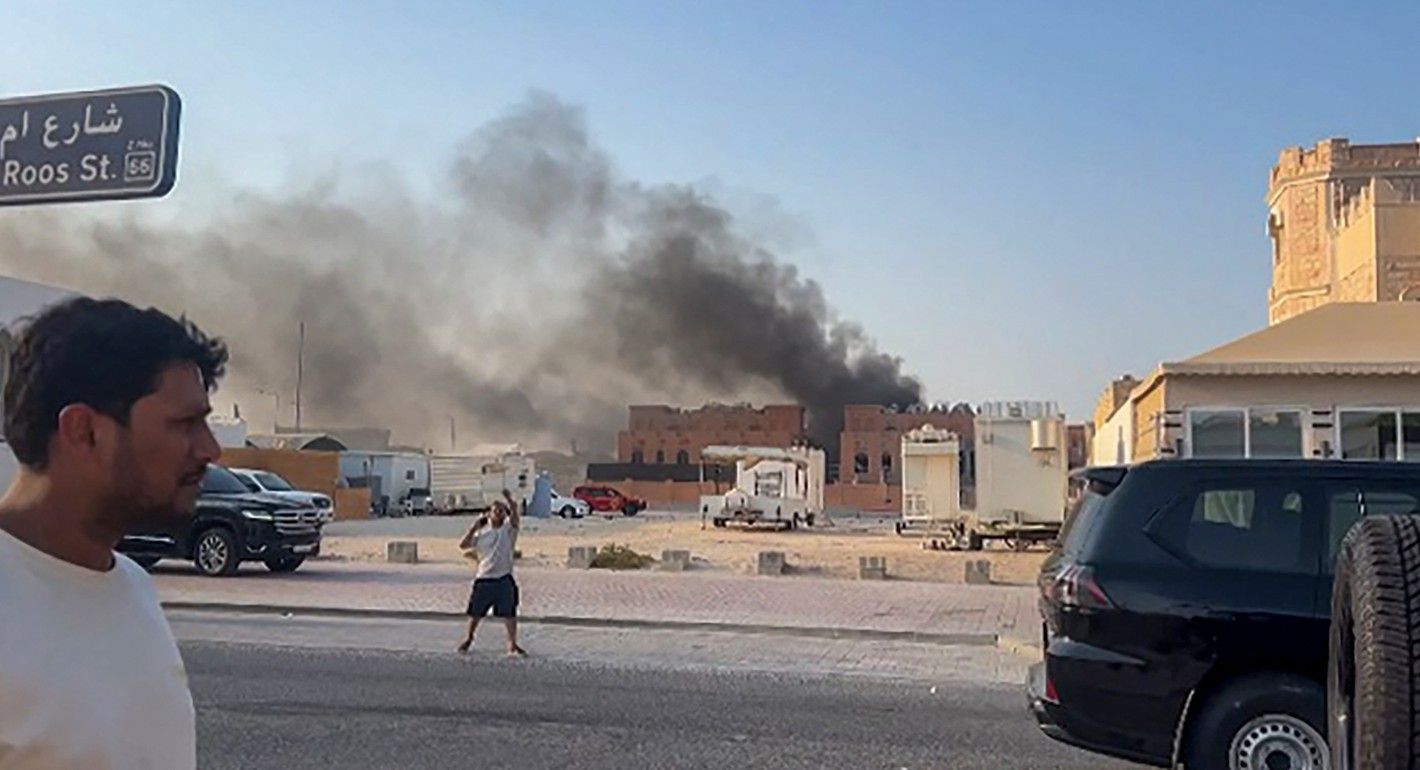
TV footage of Israeli airstrikes on Doha on September 9. (Photo by Jacqueline Penney/AFPTV/AFP via Getty Images)
The operation against Hamas in Doha has eliminated the notion that the Middle East can rely on America for protection of its lands.
Below, four Carnegie scholars react to Israel’s strikes on Hamas leaders in Doha, Qatar, and the repercussions for specific countries and the region.
Israel’s air strike in Doha on Tuesday was a wakeup call for the Gulf states: There are few limits on Israel’s ability and willingness to use military force in the region.
Qatar’s Emir Tamim bin Hamad Al Thani immediately received an outpouring of support from other Gulf Cooperation Council (GCC) leaders—not only the usual phone calls of support but high-level visits from leaders such as the UAE’s President Mohammad bin Zayed (with more to follow).
Beyond the ever-harsher rhetoric of official statements, however, it is unclear what meaningful steps the Gulf states can or will take to respond.
Kuwaiti political scientist Bader Al-Saif urged Gulf leaders to use the “tools at their disposal”—chiefly diplomatic and financial pressure—to deter Israel, while Qatar’s prime minister called for a “collective response . . . from the region.” Yet with prominent Gulf commentators already noting that “there is no longer a force capable of threatening Israel,” Tuesday’s attack underscores the GCC states’ seemingly inability to dissuade or deter Israel from further aggression—even on these states’ own soil.
During the decade-and-a-half when Iran dominated Gulf security concerns, leaders in Riyadh and Abu Dhabi could variously lean on the United States to take action against Iran (and affiliated groups) or defuse tensions with Tehran in pursuit of shared economic and security gains.
Neither option exists with respect to Israel.
Despite U.S. President Donald Trump’s periodic annoyance with Prime Minister Benjamin Netanyahu, his administration has not and will not impose financial constraints (such as cutting off aid) or military limits (such as delaying arms sales) on Israel. Netanyahu has likewise made it clear that he values prolonged conflict, rather than closer relations with the Gulf states, as a means of remaining in office. Qatar’s role as a mediator likewise holds little value if Netanyahu would rather assassinate Hamas negotiators than engage with them (with little pushback from the United States).
Saudi commentators previously ruled out direct actions such as “boycotts, embargoes, or war” in favor of building diffuse diplomatic pressure on Israel—pressure that means little so long as the Trump administration backs Israel’s continued carnage in Gaza and destabilizing military activity elsewhere.
Tuesday’s attack therefore places Gulf rulers in a dilemma: Either risk backlash in Washington and Tel Aviv by seeking to impose a cost for Israeli policies, or risk being seen by their domestic publics as acquiescing to an Israeli-dominated regional order.
The war in Gaza has repeatedly tested Moroccan-Israeli relations, which have proven remarkably resilient. But as Israeli aggression has expanded beyond Gaza’s borders, the Moroccan public has grown vocal in its calls for the government to end its normalization agreement with Israel. After the strike in Qatar earlier this week, the pressure on the government has only increased.
In late October 2023, Morocco temporarily closed the Israeli liaison office in Rabat (some quiet activity has since resumed) and suspended direct flights between Rabat and Tel Aviv. But strategic economic and military cooperation have persisted, and in some cases even intensified.
Following the news of the Israeli bombing in Doha, the Moroccan Ministry of Foreign Affairs issued a short statement “strongly condemn[ing] Israel’s heinous aggression” and denouncing “the violation of the sovereignty of the brotherly State of Qatar.” While stronger than most past Moroccan condemnations of Israeli action, the statement is relatively tame compared to those of its neighbors, which are in line with popular sentiment in the region.
Moroccan public opinion, while never overwhelmingly supportive of normalization, has fallen from 31 percent broadly in favor before October 7 to only 13 percent after the war began. Yet although Morocco has seen regular protests in support of Palestinians and against cooperation with Israel, the government has repeatedly failed to forcefully condemn Israeli aggression since October 7.
Morocco’s moderate language reflects both the success of the Moroccan-Israeli normalization agreement—which, for Morocco, has reaped significant economic gains, arms deals, and technical cooperation with Israel—and the strength of the U.S.-Moroccan relationship. Although Morocco does not consider itself part of the Abraham Accords, normalization with Israel was the price it had to pay for U.S. recognition of its sovereignty over the disputed Western Sahara territory in December 2020. That recognition, in the waning days of the first Trump administration, was a catalyst for additional countries across Europe and Africa to follow suit, moving Morocco toward its top foreign policy priority of global recognition of its sovereignty over the Western Sahara territory. Reneging on normalization could jeopardize U.S. support for Morocco’s autonomy plan.
However, the U.S.-Moroccan relationship is far deeper than Western Sahara. Morocco was the first country to recognize U.S. independence in 1777. Today, it remains a consistent U.S. partner and a major non-NATO ally. It is home to the first U.S. free trade agreement on the African continent, and it has proven to be an important actor in upholding regional stability and key to advancing U.S. interests in the region. So although the expanded bombing campaign has stepped up Moroccan public outcry over the country’s relationship with Israel, the benefits of normalization and the continued U.S.-Moroccan partnership outweigh its costs—at least for now.
Since October 7, Israel has violated the sovereignty of Iran, Lebanon, the occupied territories, Syria, Yemen, and now Qatar. If one couples these illegal actions with the repeated statements by Israeli ministers of their country’s aim to annex most of the West Bank, the primary question becomes one of Israel’s real priority: peace or annexation? The two are incompatible.
Netanyahu’s recent declaration that he believes in a “Greater Israel” cannot be dismissed as empty talk. The current Israeli coalition’s real priority appears to be to annex the occupied territories and drive out as many Palestinians as possible. The humanitarian situation is unbearable for Palestinians in Gaza—and is becoming increasingly so in the West Bank, with settlers carrying out ethnic cleansing under the eyes of the Israeli army.
The sovereignty threats also have implications for the Abraham Accords, which have normalized relations between Israel and a handful of Arab states. Expanding the agreement to include Saudi Arabia has been one of the United States’ main priorities in the Middle East under the past two administrations. The logic has been that the accords can bring regional peace, which might later drive peace between Israelis and Palestinians.
Israeli military actions since October 7, culminating in the strike on Qatar, have made it impossible for Saudi Arabia to sign any peaceful agreement with Israel that does not include a Palestinian state. Conducting a military operation against Qatar—a U.S. ally with the largest U.S. base in the region—has wiped out the notion that the Gulf can rely on America for protection of its lands. It has also painted the United States as weak, unable to prevent one ally (Israel) from striking another (Qatar). It is not inconceivable that Bahrain and the United Arab Emirates, along with other Gulf states, might rethink their policies and go as far as freezing their own normalization deals with Israel.
The question that inevitably haunts Middle Eastern governments today is: Where will the madness of Israel’s far-right government stop?
The war in Gaza is entering a new horrific phase, with widespread military operations in cities, orders to evacuate buildings and facilities, and the displacement of civilians within the strip. While repeated attacks on Lebanon and Syria continue despite ceasefire agreements here and ongoing political negotiations there, the back-and-forth between Israel and the Houthis is escalating through drones and missiles.
At the heart of all this, Netanyahu’s government continues to deliberately sabotage all mediation and negotiation efforts to end the war and release Israeli hostages and Palestinian prisoners. The Israeli strikes on Doha, which targeted the political leadership of Hamas, are nothing but the clearest message from Netanyahu and the far-right ministers in Tel Aviv: They do not welcome the efforts of mediators, are not interested in negotiating, and therefore do not want to end the war in Gaza.
Israel today is a state with rogue regional behavior. Its escalating aggression and unlimited military arrogance threaten security in the Middle East, sparking violent conflicts and arms races in a region suffering from a chronic lack of stability. It undermines existing peace agreements with some Arab countries, severely limits its chances of normalizing relations with others, and ultimately jeopardizes the interests of its people who want a secure existence in a nonhostile neighborhood.
The two-year war in Gaza has weakened Hamas militarily and politically and made its return to governing the strip—as it had practiced before October 7, 2023—unlikely. But it has not achieved Israel’s goals as defined by Netanyahu’s government: Not all Israeli hostages have been returned to their families, Hamas has not been completely destroyed, and more than 2 million Palestinians have not succumbed to the pressure of displacement outside Gaza. In addition, the war has sparked global sympathy for the Palestinians, moral and political condemnation of Israel, and a regional and international drive to end the occupation and revive the two-state solution by recognizing the state of Palestine.
The war has also jeopardized the future of the Abraham Accords. Members of the far-right Israeli government have said that the accords did not oblige it to adhere to the two-state solution or the principle of land for peace. They have claimed that friendly relations provided sufficient incentive for its neighbors to ignore the Palestinian cause and abandon their support for the Palestinians. Today, however, Netanyahu and other extremists in government operate in a regional environment that rejects them, their views, and their military arrogance. Their neighbors see their behavior as either undermining their peace agreements—as is the case with Egypt, Jordan, the UAE, and Bahrain—or as a reversal of previously looming opportunities for normalizing relations—as is the case with Saudi Arabia.
The Arab League, at the initiative of Egypt and Saudi Arabia, has recently adopted a set of collective security measures in support of an independent Palestinian state that include a provision for noncooperation with Israel. The United Arab Emirates has declared that Israel’s continued annexation and settlement policies in the West Bank constitute a breach of the Abraham Accords signed between the two parties. Jordan has frozen the Wadi Araba Peace Agreement, and Qatar is demanding international sanctions on Israel after its strikes on Doha.
Netanyahu’s talk about the evolving peace relations between his country and the Arab states, and about Israel’s friendship being the catalyst for normalization without regard for the Palestinian cause, has become the symbol of the state of denial that grips him and his government’s extremists. This is the other side of the military arrogance they practice.

Director, Middle East Program
Amr Hamzawy is a senior fellow and the director of the Carnegie Middle East Program. His research and writings focus on governance in the Middle East and North Africa, social vulnerability, and the different roles of governments and civil societies in the region.

Nonresident Scholar, Middle East Program
Andrew Leber is a nonresident scholar in the Carnegie Middle East Program.

Vice President for Studies
Marwan Muasher is vice president for studies at Carnegie, where he oversees research in Washington and Beirut on the Middle East. Muasher served as foreign minister (2002–2004) and deputy prime minister (2004–2005) of Jordan, and his career has spanned the areas of diplomacy, development, civil society, and communications.

Senior Fellow, Middle East Program
Sarah Yerkes is a senior fellow in Carnegie’s Middle East Program, where her research focuses on Tunisia’s political, economic, and security developments as well as state-society relations in the Middle East and North Africa.
Carnegie does not take institutional positions on public policy issues; the views represented herein are those of the author(s) and do not necessarily reflect the views of Carnegie, its staff, or its trustees.

Just look at Iraq in 1991.
Marwan Muasher
Tehran’s attacks are reshaping the security situation in the Middle East—and forcing the region’s clock to tick backward once again.
Amr Hamzawy
Only collective security can protect fragile economic models.
Andrew Leber
Two experts discuss how drone technology is shaping yet another conflict and what the United States can learn from Ukraine.


Steve Feldstein, Dara Massicot
Arguing that Chinese policy is hung on alliances—with imputations of obligation—misses the point.

Evan A. Feigenbaum